Urang’s First Meeting with leaseholders in 7 months: Threats of Legal Action Against Leaseholders, Secrecy, Denial and Continuing Failure to Listen
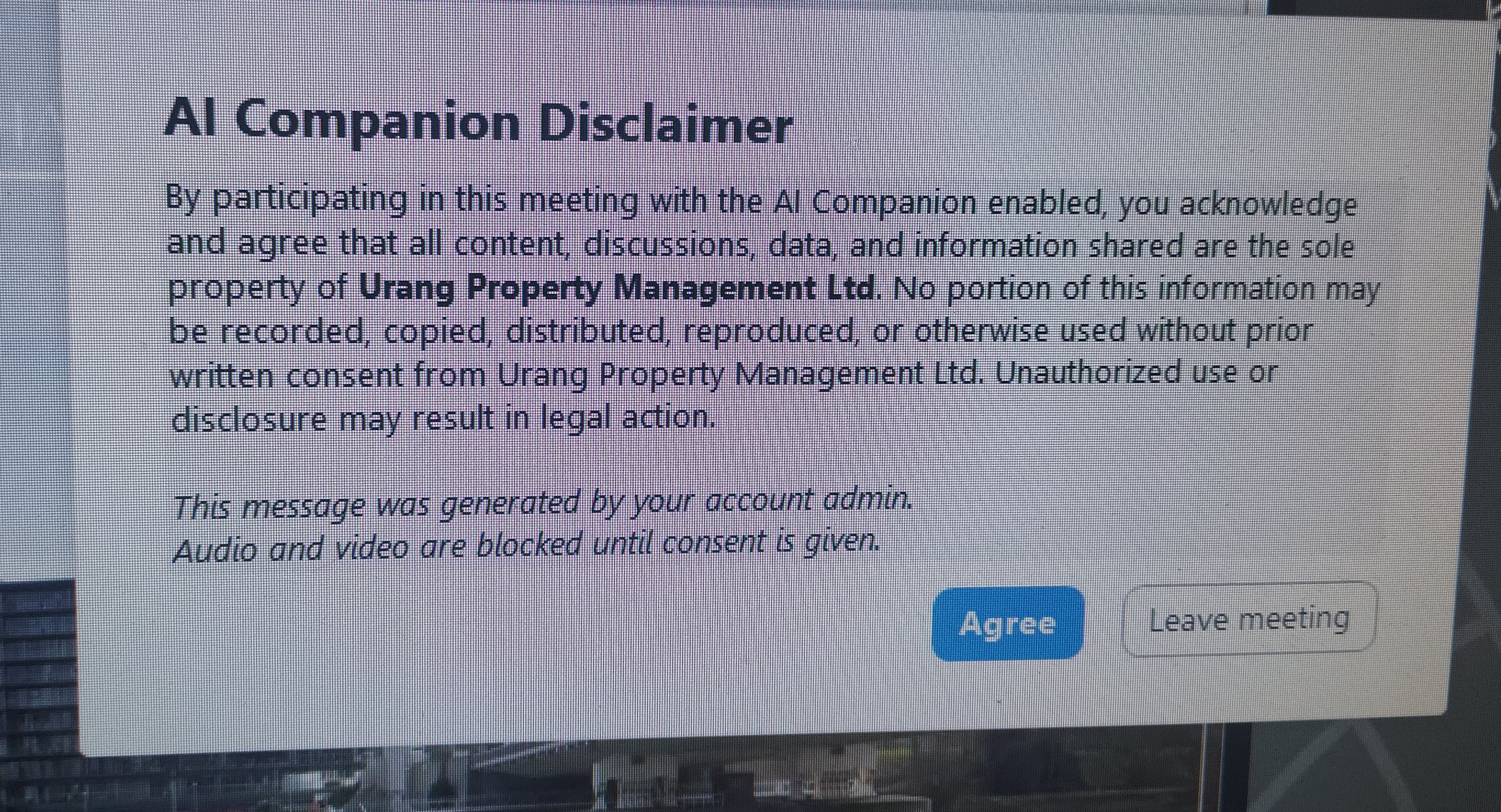
Urang and the RTM directors tried to impose secrecy on participants in the online leaseholder meeting, this evening (21st July 6.30pm) by threatning them with legal action if they publish anything about the meeting!. Those entering the zoom meeting were shown the message below (which I did not engage with either way and did not agree to). This message has no legal meaning in any case – leaseholders cannot be forced to treat their own data (i.e. what they say at a meeting) as the property of Urang.
Leaseholders cannot be forced to secrecy about a leaseholders’ meeting. It is not a reasonable expectation. But more to the point why would any reasonable or normal managing agent try to impose such terms? How does this sit with Urang’s claims of a ‘new era of transparency at Chelsea Bridge Wharf’ :). It is in my view entirely consistent with the culture of secrecy, remoteness and lack of transparency at Chelsea Bridge Wharf. So if Urang wish to pursue legal action against a resident for publishing notes of a residents’ meeting then I guess they can do that but I suggest the outcome will simply be making themselves look very foolish. There is also a strong public interest in producing these notes, as previous notes from Urang have not been fair representations of the meeting (which I can easily prove).
Notes of the Chelsea Bridge Wharf Leaseholder Meeting (21st July 2026)
Urang claimed that the meeting was intended as an update from Urang and the RTM directors on the first year of management following the Right to Manage (RTM) transition in May 2025. Urang’s presentation focused on financial management, building safety, major works and future plans. However, the discussion that followed revealed a clear divide between Urang’s positive assessment of its performance and the views of several leaseholders, particularly those who challenged the company’s claims about consultation, transparency, service charges and accountability.
Overall, while a number of residents welcomed the opportunity to hear directly from Urang and supported more regular meetings, the strongest and most detailed contributions came from residents expressing dissatisfaction with the management approach.
1. Urang’s unconvincing narrative: progress, professionalism and external pressures
Urang presented a consistently positive account of its first six months. Three priorities were emphasised:
- maintaining resident safety;
- improving the estate;
- strengthening financial controls.
Considerable emphasis was placed on:
- fire safety compliance;
- EWS1 certificates;
- recruitment of in-house staff;
- procurement savings;
- proactive maintenance;
- leak prevention;
- future investment in carpets, landscaping and lifts.
Throughout the presentation Urang repeatedly argued that increasing service charges were largely driven by national factors rather than management decisions, particularly:
- post-Grenfell building safety legislation;
- rising insurance costs;
- inflation;
- ageing high-rise buildings.
This framing attempted to position Chelsea Bridge Wharf’s financial pressures as largely unavoidable rather than unique to the estate.
2. Strong criticism of consultation and resident engagement
The most forceful criticism came from a leaseholder who challenged what he regarded as Urang’s unjustified claims that residents were being consulted. His principal argument was that Urang had confused consultation with communication. He argued that:
- residents had never been formally consulted on priorities;
- no results had been published;
- residents were simply being asked to email Urang with individual concerns;
- Urang then selectively interpreted those concerns as ‘consultation’ or the views of most residents.
He described repeated invitations to “join the conversation” as:
“really insulting to our intelligence”
He argued that genuine consultation would involve:
- asking all leaseholders for their priorities;
- publishing results;
- allowing residents to scrutinise decisions.
This represented perhaps the strongest challenge made during the meeting because it questioned not simply a specific management decision but Urang’s overall approach to governance.
3. Service charges and financial transparency
The second major area of criticism concerned finances. Leaseholders disputed Urang’s assertion that service charges had effectively remained stable and several stated that they had increased. because:
- reserve fund contributions (which Urang admitted had increased considerably) ARE part of the service charge;
- separating reserve contributions from operational service charges was misleading;
- Warwick service charges had increased above inflation.
A leaseholder referred to the previously announced £420,000 potential overspend, expressing scepticism that Urang could now claim the position was much more favourable while simultaneously being unable to provide a final figure. His broader criticism was that after years campaigning for Right to Manage:
- service charges had not reduced;
- residents had not gained greater influence;
- promised benefits had not materialised.
This was a recurring underlying theme: whether RTM had actually delivered the improvements originally promised.
Questions from a leaseholder about the apparent abandonment of TWO section 20 processes (one from December 2025 for lift and carpet replacement and one from April 2026 for lift replacemet and refurbishment) were not addressed by Urang at all who replied with comments about a different matter (the Section 20B notice about the £420,00 service charge budget overspend).
4. Dissatisfaction with communication
Communication emerged as one of the strongest recurring themes. Several residents expressed frustration.
Issues raised included:
- unanswered Prospero tickets;
- promised telephone calls not returned;
- delays in responses;
- difficulty contacting staff while working;
- preference for face-to-face meetings.
One resident described communication as: “extremely challenging”
Another questioned the visibility and productivity of estate staff, commenting that they often appeared to be standing around talking rather than working.
These comments suggested that dissatisfaction was not confined to strategic issues but extended to everyday operational management.
5. Calls for more openness and accountability
Several contributors requested:
- quarterly meetings (hybrid – not online only);
- clearer reporting of progress;
- opportunities to question managers and RTM directors directly.
One leaseholder raised a related point concerning RTM directors themselves, asking how residents could hear directly from directors regarding priorities rather than solely through managing agents. Urang were unwilling to provide direct acess to the RTM directors who are
Louis-Sebastian Kendall
Stephen Julian Thompson
Ivo Edzard Knotternus
Robert Spittle
Katherine Francis Greenway
These directors were ‘elected’ in a farcical and undemocratic nine minute AGM in December 2025.
Leaseholders expressed serious concerns regarding the visibility and accountability of the RTM directors. Urang claimed the directors were ‘active in various forums’ but could not identify which forums they meant nor specifiy any activity by these directors. There are supposedly weekly meetings between Urang and the Directors but leaseholders are not allowed to attend these meetings nor to see any notes from them.
6. Building safety and EWS1
Building safety occupied a significant proportion of the meeting.
Residents were particularly concerned about:
- Warwick’s expired EWS1 certificate;
- delays obtaining licences;
- remortgaging difficulties;
- uncertainty regarding safety.
The RTM director reinforced these concerns, stressing that the issue was not solely financial but related to resident safety and confidence.
Urang consistently argued that delays lay largely with external organisations, particularly:
- Berkeley Homes;
- freeholders;
- regulatory requirements.
Residents appeared broadly accepting of the complexity, although frustration remained over the length of delays.
7. Estate improvements versus basic maintenance
Urang presented an ambitious programme involving:
- carpets;
- landscaping;
- lift modernisation;
- redecorations.
However, residents frequently reframed these not as improvements but as long overdue maintenance.
Urang clained that much of the work was intended simply to restore Chelsea Bridge Wharf to the standard it should already have achieved but they could not point to any meaningful evidence that their priorities were shared by leaseholders.
Residents also highlighted unresolved operational issues including:
- faulty intercoms;
- EV charging;
- Sopwith Way cleanliness;
- car park management.
These examples reinforced a perception among some residents that everyday maintenance remained inconsistent despite the strategic plans being presented.
8. Leaseholders asked for
- genuine consultation
- quarterly meetings (hybrid – not online only)
- commercial income generation;
- EV charging opportunities;
- greater use of underused parking;
- better engagement with Battersea Power Station regarding cleaning costs.
These comments demonstrated that residents were generally willing to engage constructively where they felt their suggestions were genuinely considered.
Overall assessment
The dominant theme emerging from the discussion was a lack of trust between some leaseholders and Urang.
Urang sought to demonstrate professionalism, regulatory compliance and careful financial stewardship. Several residents, however, questioned whether these achievements translated into tangible benefits for leaseholders.
The strongest criticisms centred on:
- lack of genuine consultation;
- insufficient transparency over finances;
- limited accountability of RTM directors;
- weak communication;
- failure to deliver the lower service charges and stronger resident voice that many associated with Right to Manage.
Although Urang responded calmly throughout and attempted to explain many issues by reference to regulation or external constraints, these explanations did not appear to satisfy leaseholders.
The meeting therefore revealed an important tension: Urang viewed itself as successfully stabilising a complex estate, whereas several residents believed the promised cultural change following RTM—greater transparency, consultation and resident influence—had yet to materialise.
Agreed actions and commitments
The following actions were either explicitly agreed or clearly committed to during the meeting:
| Action | Responsibility |
|---|---|
| Consider holding quarterly leaseholder meetings | Urang |
| Consider future in-person or hybrid meetings where feasible | Urang |
| Provide written responses to unanswered questions submitted in the chat | Urang |
| Continue legal pressure on Berkeley Homes regarding Warwick EWS1 licences | Urang / RTM |
| Encourage residents to contact Berkeley Homes to support EWS1 progress | Residents and RTM |
| Continue exploring additional income streams (parking, EV charging, commercial opportunities) | Urang |
| Investigate faulty Warwick/P1 intercom reported during the meeting | Urang |
| Review outstanding Prospero communication failures | Urang |
| Continue window cleaning programme | Urang |
| Proceed with carpet replacement programme during 2026 | Urang |
| Continue planning gateway applications for lifts, entrances and internal refurbishments | Urang |
| Continue discussions with Battersea Power Station regarding Sopwith Way management and security | Urang |
| Continue pursuing removal of the six-bay car wash operated by Berkeley Homes | Urang |
There was also a lively discussion in the comments section of the zoom meeting and a full account of that will be provided shortly. As meaningful discussion is impossible on the CBW app, residents may wish to join our facebook group https://www.facebook.com/groups/cbwcommunity where there is freedom of speech,.
Urang are such bullshitters. Bella kept going on about ‘have your say’ , ‘join the conversation’ and other cliches but in fact they haven’t consulted leaseholders on anything in the 14 months since they took over. Apart from the colour to repaint the fences. They really do think we are stupid. Ditto for the claim that service charge has not increased – a claim whicnis only true if you exclude the whopping contribution to resrve funds that they have imposed. This is of course part of the service charge in reality. So service charge has gone up way above inflation and clealry they have a huge spending programme planned, without consultation or conseny. They and the RTM directors have no interest in leaseholders – they need to go IMHO.
LikeLike
Yes it was a shocking exercise in evasion and spin. They clearly are pressing ahead with major expenditure programmes (‘4 year plan’!) which have no mandate at all from leaseholders and inevitably mean more service charge increases going forward. Hilarious references to ‘gateway applications’ (section 20s) – basically admitting their agenda to spend large amounts of our money. I have zero confidence in them and find the fake coporate spin of Bella particularly stomach churning. I think they imagine they can continue like this indefintely – I think otherwise.
LikeLike